How Fellow's Data Retention Settings Give Compliance Teams The Flexibility They Need
•
5
MIN READ

AI Summary by Fellow
Every meeting your organization runs produces something valuable: decisions made, commitments given, context shared. But in regulated industries like financial services, healthcare, legal, and others, that same meeting record can also represent a liability. Verbatim recordings and transcripts sit at the intersection of operational value and regulatory risk, and the longer they're retained, the more exposure a firm carries.
Fellow is the only AI notetaker that is purpose-built for this reality. It doesn't ask compliance teams to choose between capturing meeting intelligence and managing their data obligations. Instead, it gives them the controls to do both on their terms, enforced automatically across the entire organization.
This post walks through how Fellow's data retention settings work, how to configure them, and the flexibility these settings offer legal and compliance teams trying to align data handling with their firm's specific regulatory posture.
How Zero-Day retention works in Fellow
Zero-day retention, or ZDR, is Fellow's most protective data handling configuration. It is designed for firms that need the output of a meeting, such as the summary, the key decisions, and the action items, but cannot afford to retain the underlying recording or verbatim transcript beyond the moment it has served its processing purpose.
Here is what happens when ZDR mode is active:
The meeting gets recorded
Fellow records, processes, and generates AI meeting notes, summaries, and action items from the transcript of the call. Then, immediately upon processing, the source recording and raw transcript are permanently deleted. Not archived. Not flagged for future review. Deleted. This process applies to both video and audio-only recordings.
The AI-generated outputs remain intact and accessible to the team
While the most important elements of the meeting remain, the compliance liability, such as the verbatim record that would be subject to discovery, litigation hold, or regulatory review, is gone. This is what makes ZDR the most defensible posture available within Fellow. The intelligence from the meeting is preserved exactly where it is useful: in the summary, the follow-ups, the documented decisions. The raw material that creates legal exposure is eliminated at the point of origin.
Deletion is permanent and irreversible
It is worth being clear about what "deleted" means in Fellow's architecture. All deletion is permanent and irreversible. This is by design. A soft delete or an archival process that can be reversed does not carry the same compliance weight as a true and auditable removal. When Fellow deletes a recording under ZDR, it is gone, and that finality is precisely what makes the setting meaningful for compliance teams working under strict data governance requirements.
How to Configure Fellow's Data Retention Settings
Fellow's retention architecture is governed at the workspace level, which means a compliance or IT administrator sets the rules once and they apply uniformly across the entire organization: every team, every meeting type, every business unit. There is no need for individual users to manage their own settings, and no risk of policy drift from team to team. Here’s how to configure Fellow’s data retention settings within your account:
Enable Zero-Day retention
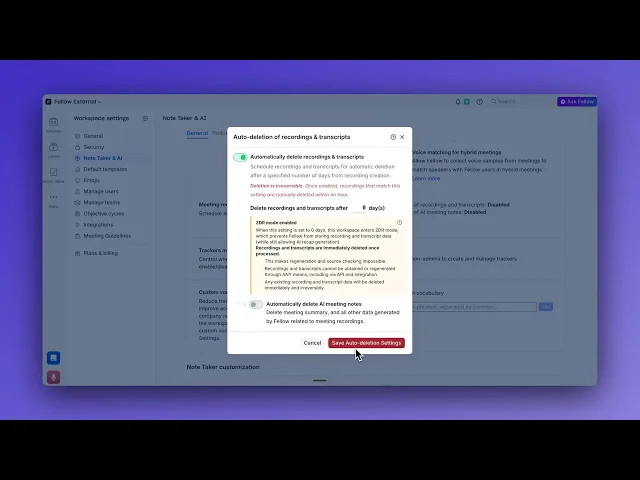
To enable ZDR, an administrator navigates to workspace settings and enables the zero-day retention setting, setting the retention window to zero days. The workspace enters ZDR mode immediately upon saving. From that point forward, all meetings processed by Fellow in that workspace follow the zero-day rule automatically.
Configure standard retention windows
Zero-day retention sits at one end of the spectrum. For firms that are required — whether by regulation, internal policy, or contractual obligation — to retain recordings and transcripts for a defined period, Fellow supports fully configurable retention windows. Administrators can set retention to 60 days, 90 days, 365 days, 750 days, or any window that fits their firm's requirements. The compliance team defines the parameters, and Fellow applies them without any ongoing manual intervention.
Configure retention for AI-generated outputs
Separately from source recordings and transcripts, Fellow provides independent retention controls for AI-generated meeting notes, summaries, action items, and all associated data produced from a recorded meeting. This is configured as its own setting, distinct from the retention window applied to raw recordings. The window for AI-generated outputs can be set as short as one day, or extended to five days, 365 days, 750 days, or up to 1,000 days, entirely determined by the firm's requirements.
This separation is intentional and important. It means the retention schedule for a verbatim transcript does not have to match the retention schedule for the AI summary derived from it. The two are governed independently.
The flexibility retention policies give compliance and legal teams
The most significant capability Fellow's retention architecture provides is what is best described as the decoupled retention model. Source recordings and AI-generated outputs are treated as distinct data types, each with its own configurable lifecycle. This matters enormously for firms operating under regulatory constraints.
Eliminating liability while preserving institutional memory
In practice, the decoupled model lets a firm do something that would otherwise require a difficult tradeoff: delete raw recordings on the compliance schedule that minimizes discovery exposure, while retaining AI summaries for as long as the firm needs them as a record of decisions and commitments. The verbatim transcript, which is the data type that carries the most regulatory weight, can be eliminated immediately or after a short defined window. The structured, processed output, such as the meeting notes, action items, summaries, can live in the system for years, serving as institutional memory without carrying the same compliance liability.
For firms navigating broad discovery exposure, this distinction is material. A processed summary that captures what was decided is categorically different from a recording of what was said, and Fellow's retention architecture reflects that distinction in the controls it provides.
Governance that scales automatically
Beyond the specific configurations available, the workspace-level governance model itself is a meaningful capability for compliance teams. In large organizations with many teams and meeting types, the alternative to centralized enforcement is policy fragmentation: individual teams managing their own settings, inevitably inconsistently. Fellow eliminates that risk. The compliance team defines the retention rules once, and those rules are enforced uniformly and automatically at scale.
This also means that when a firm's regulatory obligations change, such as a new rule comes into effect, a litigation hold is imposed, or an internal policy is updated, the compliance team can update the workspace settings and have the new policy apply immediately across the entire organization, without having to coordinate with individual team administrators or retrain users.
A posture built for regulated industries
Fellow's data retention settings reflect a broader design philosophy: that regulated firms should not have to compromise between capturing the value their meetings produce and managing the obligations that come with data retention.
The intelligence that meetings generate, the clarity on direction, the record of commitments, the context for future decisions, is real and worth preserving. However, the compliance liability that comes with retaining verbatim recordings indefinitely is also real, and worth managing carefully.
Fellow gives compliance and legal teams the controls to handle both without forcing a choice between them.
Record, transcribe and summarize every meeting with the only AI meeting assistant built with privacy and security in mind.