AI Meeting Assistant for Fintech: How to Turn Every Meeting Into Compliant, Searchable Intelligence
•
5
MIN READ
AI Summary by Fellow
Fintech teams run on meetings. Client calls, investment committee reviews, compliance check-ins, recruiter interviews, quarterly planning sessions — the list is long. And every one of those conversations carries risk when documentation is incomplete, inconsistent, or stored in the wrong place.
Most AI meeting tools were built for general knowledge workers. Fintech teams aren't general knowledge workers. They operate under SEC, FMA, GDPR, and HIPAA obligations. Their meetings contain personal financial information and material non-public information. Their compliance directors have approval authority over any tool that touches client interaction records. Their CISOs are already worried about shadow AI.
If your team is evaluating an AI meeting assistant and needs to get it past legal, compliance, and IT security — this guide is for you.
Why standard AI notetakers don't work for fintech
The appeal of AI meeting assistants is obvious. Instead of splitting attention between listening and note-taking, advisors and analysts can stay fully engaged in the conversation. Structured notes, decisions, and action items are generated automatically. Meeting recaps land in inboxes without anyone having to write them.
The problem is that most fintech teams discover compliance blockers only after they've started a pilot.
Here's what comes up in nearly every fintech evaluation:
Where is the data stored, and what happens to it if we cancel? Data residency and portability aren't afterthoughts for regulated firms — they're procurement requirements. Teams need to know that their meeting data lives in a defined environment and can be exported or deleted on exit.
Who can see what? An advisor's client calls shouldn't be accessible to other advisors. Compliance officers, on the other hand, may need workspace-wide visibility for audit purposes. Most general-purpose tools offer no meaningful role-based scoping.
What triggers archiving obligations? In regulated environments, how meeting notes are shared matters as much as what they contain. Automatic email distribution of meeting recaps can trigger SEC archiving obligations — a risk most teams don't discover until after they've deployed.
Are the controls admin-enforced or user-optional? This is the question compliance directors always ask. A tool that lets individual users toggle security settings on or off is not an enterprise compliance solution. Controls need to be set at the workspace level and enforced uniformly.
Is AI being trained on our client data? This is a non-negotiable for firms handling personal financial information. A vendor that doesn't offer a written commitment against training AI on customer data will not pass most fintech security reviews.
These aren't edge-case concerns. They're the exact questions that determine whether an AI meeting assistant gets approved or rejected. Any tool evaluation that doesn't address them upfront will eventually stall at the compliance gate.
What fintech teams actually need from an AI meeting assistant
Before getting into capabilities, it's worth naming the core tension that makes this category hard for fintech.
Advisors and analysts want less friction. They're back-to-back in client calls and internal reviews all day. Anything that reduces note-taking overhead, surfaces commitments automatically, or helps them prep for the next call faster is genuinely valuable.
Compliance officers want more control. Every meeting that contains client information is a potential liability. They need consistent documentation, defined data lifecycles, and the ability to audit records without chasing down individuals.
These goals aren't inherently in conflict, but most AI meeting tools are built to serve one or the other — not both. Advisors end up with shadow AI tools that compliance hasn't vetted. Compliance ends up with blanket bans that slow the business down.
The right AI meeting assistant for fintech resolves this tension by giving compliance teams the admin-enforced controls they need while removing friction for the advisors and analysts who use it every day.
The compliance concerns that come up in every fintech meeting tool evaluation
Data retention
Fintech teams frequently face conflicting data retention pressures. Regulatory frameworks may require that certain records be kept for a defined minimum period. Privacy regulations like GDPR create rights to erasure that pull in the opposite direction. And operational teams often want to keep useful documentation for as long as possible.
A meeting assistant that supports configurable workspace-level auto-deletion gives compliance teams the consistency they need. The retention period is set once, applied uniformly across all meetings, and enforced automatically — no manual cleanup required.
Role-based access and compliance visibility
Advisors should see their own meetings. Compliance officers need to see across the workspace. These are different requirements that require different access levels.
The right configuration gives each persona exactly the access they need. Client-facing teams are scoped to their own recordings. Compliance and operations leadership get the workspace-wide visibility needed to fulfill audit and oversight functions. Neither group can access what they shouldn't.
Shadow AI and unvetted tools
The shadow AI problem is already present in most fintech organizations. Employees are using AI tools — the question is whether those tools have been vetted.
An AI meeting assistant that can actually pass a security review — SOC 2 Type II certified, HIPAA compliant, GDPR aligned, with a written commitment against training AI on customer data — gives organizations a path to consolidation. Instead of chasing down which tools employees are using and trying to prohibit them, firms can offer a sanctioned, compliant alternative that actually meets advisors' and analysts' needs.
How Fellow addresses fintech compliance requirements
If the compliance blockers above sound familiar, Fellow was built to address exactly this environment.
Security credentials that pass procurement review
Fellow is SOC 2 Type II certified, HIPAA compliant, and GDPR aligned. Fellow never trains AI models on customer data — a commitment made in writing. Security and legal teams can request SOC 2 report review and mutual NDA execution as part of a formal procurement process.
Data is encrypted at rest and in transit. SSO and SCIM provisioning are available via Active Directory for enterprise identity management.
These aren't marketing claims. They're the specific credentials that fintech compliance and IT security teams ask for in vendor evaluations.
Workspace-level auto-deletion
Fellow's auto-deletion automatically removes recordings and transcripts after a configured period. The retention policy is set at the workspace level and applies uniformly across all meetings in the workspace.
AI summaries can survive after the underlying recording is deleted. This means teams retain structured documentation — decisions, action items, discussion points — without keeping raw audio or video files that create storage and privacy exposure.
For firms with more advanced retention requirements or formal audit trail needs, additional compliance oversight capabilities are available. Book a call with our team to understand what's available for your firm's specific needs.
Redaction for sensitive content
When sensitive content needs to be removed from a meeting record — a client's personally identifiable information, a discussion that was inadvertently captured — Fellow supports permanent redaction from the transcript and video recording. The selected segment is clipped from the recording entirely, not just hidden.
Redaction permissions are admin-configured. The workspace administrator decides which team members have access to perform redactions. This isn't a feature that's automatically available to all users.
One nuance worth understanding: redacting the AI summary after removing content from the transcript and recording is a user-controlled choice at the time of redaction. The transcript and recording are always permanently removed; whether to regenerate the AI recap to exclude the redacted content is a separate step.
Botless recording for sensitive client calls
Fellow supports botless recording for calls where a visible AI bot creates complications. Calls where recording consent is a concern can be handled differently from routine internal meetings, without requiring a blanket policy that treats every meeting identically.
CRM integrations
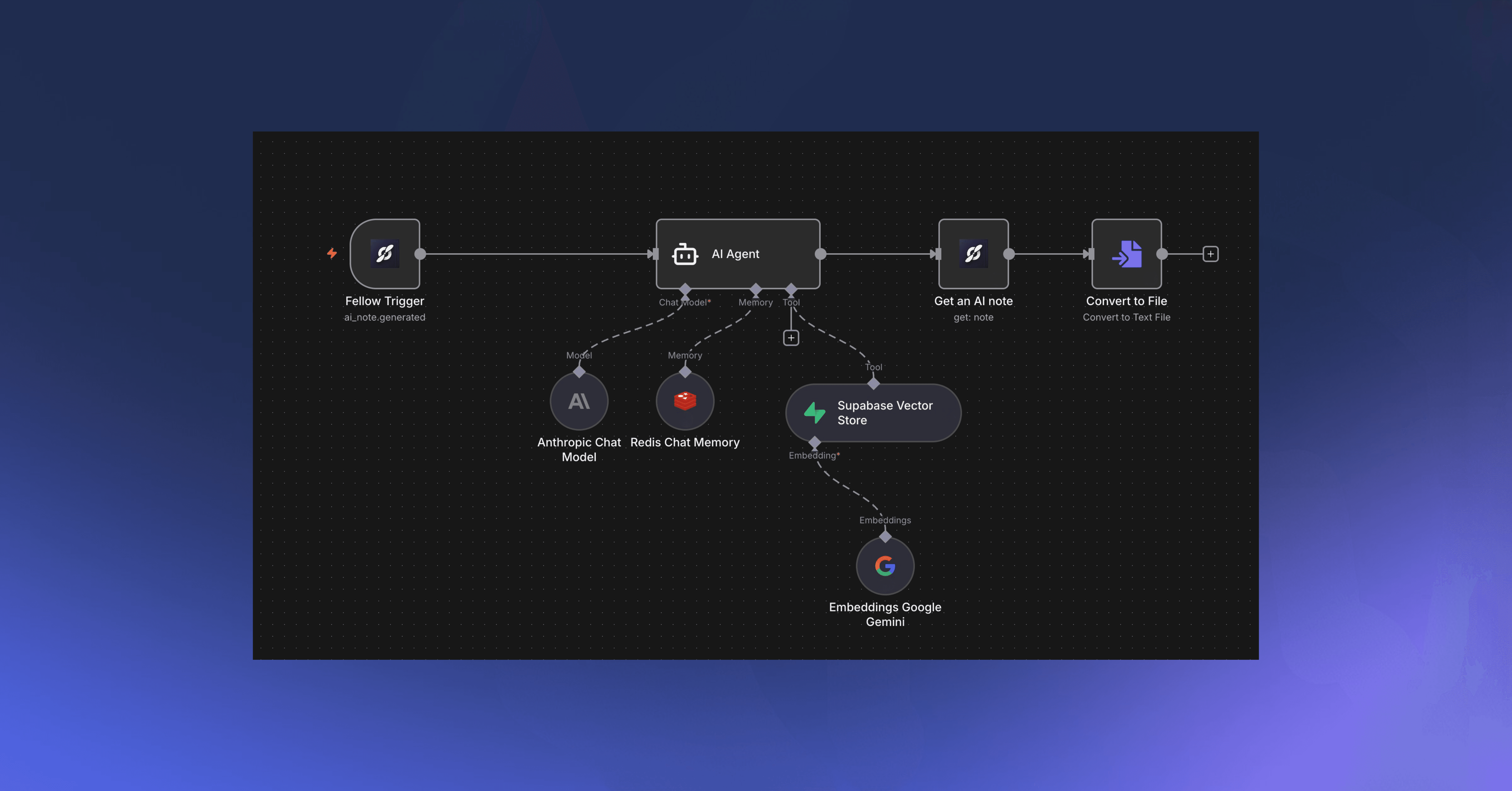
Meeting notes and action items flow directly into your CRM after every call.
Fellow's API lets teams connect Fellow to portfolio management systems and CRM platforms, automatically syncing meeting records and action items to the relevant client or deal record. Full documentation is available at developers.fellow.ai.
Both Backstop and Dynamo support API-based integrations, making this a straightforward implementation for an in-house developer or technical operations resource.
What fintech teams are actually doing with Fellow
The use cases that show up most consistently in fintech deployments are worth walking through in detail.
Recruiting and candidate interviews
Recruiting teams in fintech run high volumes of candidate interviews. Manual note-taking during interviews degrades quality — interviewers are splitting attention between listening and writing, which affects both the conversation and the accuracy of notes.
AI-generated meeting notes from candidate interviews give recruiting teams structured documentation they can actually use: what the candidate said, what commitments were made, what follow-up was agreed. Custom AI templates designed for recruiting use cases can prioritize candidate responses over interviewer talking time, which produces more useful output than a generic summary.
There's also a compliance dimension specific to AI in recruiting. Ontario, for example, has introduced requirements around disclosure of AI usage in the hiring process. Having clear documentation of how AI is used — and what it captures — makes compliance with these emerging requirements more straightforward.
Client-facing advisory meetings
Advisors spend significant time on client calls. Every one of those conversations contains commitments, decisions, and follow-up items. When notes are taken manually or not taken at all, those commitments live in memory rather than in a documented record.
An AI meeting assistant changes this. Instead of an advisor writing up a client call after the fact (if they write it up at all), structured notes and action items are generated automatically. The advisor can stay present in the conversation rather than managing a notepad. The client gets consistent follow-through because commitments are tracked, not remembered.
For compliance, the upside is that every client interaction is documented consistently, automatically, and in a format that's searchable and auditable.
Investment committee and internal review meetings
Investment teams make consequential decisions in meetings. What gets decided, who committed to what, what was flagged for follow-up — these are exactly the details that matter later and exactly the details that disappear when there's no structured documentation.
Ask Fellow lets investment teams query across their meeting history using natural language. "What did we decide about the Q3 rebalancing?" surfaces the answer from the meeting where it was discussed. "What commitments are at risk?" draws on action item records across multiple meetings. The institutional knowledge that used to walk out the door with departing analysts becomes searchable and accessible.
Operations and lean team efficiency
Fintech operations teams are typically small and spread across a wide range of responsibilities. Every hour spent on manual documentation is an hour not spent on higher-value work.
Teams that have deployed Fellow consistently report that the efficiency gains are significant and that adoption happens quickly once people see the tool working. The reaction is often some version of "this feels like it shouldn't be possible" — which is a sign that the tool is genuinely solving a real problem rather than adding complexity.
Fellow vs. general transcription tools: what's different
It's worth being direct about what separates Fellow from general transcription tools, because the category distinction matters for fintech evaluation.
Feature | Fellow | General transcription tools |
|---|---|---|
Security certification | SOC 2 Type II, HIPAA, GDPR | Varies; often consumer-grade |
Admin-enforced controls | Workspace-level, cannot be user-overridden | Often user-controlled |
Auto-deletion | Workspace-level, configurable | Rarely available |
Redaction | Permanent, from transcript + recording + optional AI summary | Rarely available |
Botless recording | Supported | Rarely supported |
Role-based access | Compliance-scoped visibility | Typically flat access |
AI model training | Never; committed in writing | Often used for model improvement |
CRM integration | Via REST API; supports Backstop, Dynamo, Salesforce | Limited |
Cross-meeting intelligence | Ask Fellow: query across all your meetings | Not available |
The distinction that matters most for fintech is not transcription quality — that's table stakes. It's whether the tool can actually operate in a regulated environment with admin-enforced controls, documented data governance, and security credentials that pass a procurement review.
General transcription tools are built for convenience. Fellow is built for organizations where meeting documentation has compliance implications.
How to evaluate an AI meeting assistant for fintech
If your team is running a formal evaluation, here's a framework for the questions that matter most.
Security and compliance documentation: Ask for the SOC 2 Type II report. Ask whether HIPAA compliance is certified or self-attested. Ask specifically whether the vendor trains AI models on customer data, and ask for that commitment in writing. Ask whether NDA execution is available for the procurement process.
Admin-enforced controls: Ask specifically whether recording defaults, email sharing, and access permissions are set at the workspace level or the user level. A vendor that can't clearly answer this question doesn't have the admin controls fintech teams need.
Data retention: Ask how auto-deletion works, what the configurable options are, and whether AI summaries can be retained after raw recordings are deleted. Ask about the audit trail for deletion events and what documentation is available for compliance review.
Redaction: Ask whether permanent redaction from transcript and recording is available. Ask how redaction permissions are configured and whether it's automatically available to all users or admin-controlled.
Role-based access: Ask how compliance officer access is configured versus advisor or analyst access. Ask whether workspace-wide visibility can be scoped to specific roles without giving those roles access to other settings.
CRM integration: Ask specifically how integration with your CRM or portfolio management system works, whether it's a native integration or API-based, and what developer resources are required.
Pilot terms: Ask about data handling during a pilot, including what happens to recorded data if you choose not to proceed, how data export works, and whether deletion is verifiable.
Frequently asked questions
What makes an AI meeting assistant compliant for fintech?
A compliant AI meeting assistant for fintech needs to clear several bars simultaneously. It should be SOC 2 Type II certified, HIPAA compliant, and GDPR aligned at minimum. It should offer a written commitment against training AI models on customer data. Admin-enforced controls at the workspace level (not user-optional settings) are essential for regulated environments. Configurable data retention with workspace-level auto-deletion addresses the data lifecycle requirements that compliance teams need to demonstrate to regulators. No single credential makes a tool compliant, but the combination of security certification, admin-enforced governance, and a documented data commitment is the baseline for serious fintech evaluation.
Can Fellow recordings be redacted if sensitive information is captured?
Yes. Fellow supports permanent redaction of sensitive content from meeting recordings. When redaction is performed, the selected segment is permanently removed from both the transcript and the video or audio recording — it's clipped out, not hidden. You can also choose to regenerate the AI summary so it reflects the redaction, though this is an optional step at the time of redaction, not automatic. Redaction permissions are admin-configured: the workspace administrator decides which team members have access to perform redactions, so it's not automatically available to all users.
Stop letting meeting intelligence disappear
Every client call, investment committee meeting, and compliance review your team runs contains context, commitments, and decisions that matter. Right now, most of that intelligence lives in notes that are incomplete, inconsistent, or inaccessible to anyone but the person who wrote them.
Fellow turns every meeting into searchable, documented intelligence. Compliance teams get admin-enforced controls and audit-ready records. Advisors and analysts get structured notes without the note-taking burden. Operations leaders get consistent documentation across the entire team, automatically.
SOC 2 Type II certified. HIPAA compliant. GDPR aligned. Never trains on your data. Works with Zoom, Google Meet, Teams, in-person meetings, and Slack huddles. Connects to your CRM via API.
If you're at the compliance evaluation stage and need to talk through your firm's specific requirements: Book a call with our team →
Your meetings already contain the answers your firm needs. Fellow helps you find them.
Record, transcribe and summarize every meeting with the only AI meeting assistant built with privacy and security in mind.