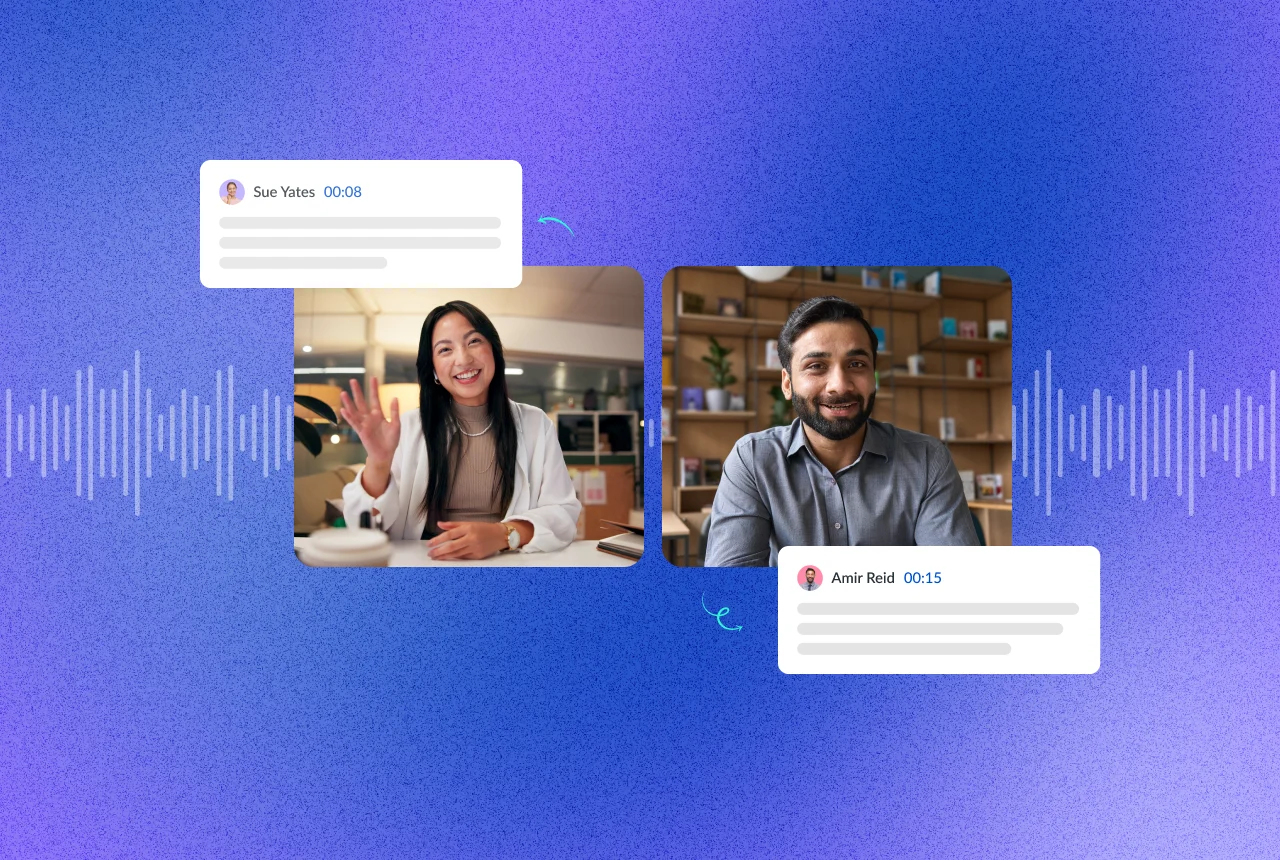
Virtual Meetings in 2026: Types, Best Practices, and How to Make Every Call Count
•
8
MIN READ

AI Summary by Fellow
Virtual meetings have become the backbone of how modern teams collaborate. Whether your organization is fully remote, hybrid, or simply spread across multiple offices, the ability to connect face-to-face through a screen is no longer optional.
But here's what most guides about virtual meetings miss: the meeting itself is only half the challenge. The real problem is what happens after. Decisions get forgotten. Action items slip through the cracks. That critical piece of context from last month's call? Gone.
If you're tired of virtual meetings that generate conversation but not results, there's a better approach. Fellow is a secure AI meeting assistant that captures every virtual meeting and turns it into searchable intelligence your entire team can access. Start your free trial →
This guide covers the three main types of virtual meetings, when to use each one, and how to ensure your virtual conversations actually drive outcomes.
What are the different types of virtual meetings?
Virtual meetings fall into three primary categories, each designed for different communication needs. Understanding when to use each type helps teams choose the right format for their objectives.
Video conferences
Video conferencing is the most common type of virtual meeting for day-to-day team collaboration. Participants join a call where everyone can see and hear each other through their screens, creating the closest approximation to in-person interaction.
Best for: Team syncs, project discussions, brainstorming sessions, client calls, and any meeting where reading facial expressions and body language matters.
How video conferences work:
A host schedules the meeting and sends calendar invites with a joining link
Participants join via desktop app, browser, or mobile device
Everyone can toggle their camera and microphone on or off
The host (or participants) can share their screen to present documents, slides, or demos
Features like reactions, polls, chat, and breakout rooms enable real-time engagement
Advantages of video conferencing:
Creates stronger personal connection than audio-only calls
Allows real-time collaboration on shared content
Supports engagement features like reactions, polls, and chat
Enables visual cues that improve communication clarity
Challenges to consider:
Requires stable internet for quality video transmission
Can cause fatigue when overused (often called "Zoom fatigue")
Technical issues with cameras, microphones, or connectivity can disrupt flow
Without proper capture tools, decisions and context from video calls disappear after the meeting ends
Audio conferences (teleconferences)
Audio conferencing connects participants through voice only, either via traditional phone lines or internet-based calling. Without video, these calls typically work best with a clear facilitator who guides the conversation.
Best for: Quick check-ins, calls with participants who have limited bandwidth, large announcements where most participants listen rather than speak, and international calls where phone connectivity is more reliable than video.
How audio conferences work:
A host sets up a conference line or audio meeting room
Participants dial in using a phone number and access code, or join via an app
One facilitator typically leads the discussion and manages who speaks
Participants mute when not speaking to reduce background noise
Advantages of audio conferencing:
Works reliably even with poor internet connections
Simpler technology with fewer potential failure points
Participants can join from anywhere with phone service
Less fatiguing than video for longer sessions
Challenges to consider:
Difficult to gauge participant engagement without visual cues
Multiple speakers can talk over each other without visual signals
Harder to build rapport compared to video interactions
Note-taking becomes even more critical since there's nothing to reference visually
Webinars
Webinars are one-to-many virtual presentations where hosts broadcast to an audience. Unlike video conferences, attendees typically cannot see or interact with each other directly. Communication flows primarily from presenters to viewers, with limited audience participation through Q&A, polls, or chat.
Best for: Product demos, training sessions, thought leadership presentations, company-wide announcements, lead generation events, and any scenario where one or few people need to communicate to many.
How webinars work:
Organizers schedule the event and create a registration page
Attendees register in advance, providing contact information
On the event day, presenters broadcast while attendees watch
Audience engagement happens through polls, Q&A submissions, and chat
Hosts can choose to make questions visible to all or keep them private
Advantages of webinars:
Scales to hundreds or thousands of attendees efficiently
Registration captures leads and attendee information
Attendees can focus on learning without pressure to participate visibly
Recordings can be repurposed as on-demand content
Challenges to consider:
Limited real-time interaction compared to video conferences
Easier for attendees to disengage or multitask
Questions may go unanswered in large sessions
Requires more production effort to keep audiences engaged
Why do virtual meetings fail to deliver results?
The technology for connecting virtually has never been better. So why do teams still struggle to get value from their virtual meetings?
The answer usually is not the call quality or the platform. It's what happens to the information after the meeting ends.
Consider a typical virtual meeting: your team discusses a critical project decision, assigns action items, and agrees on next steps. A week later, someone asks what was decided. Nobody remembers exactly. The action items? Some got done, others were forgotten entirely. The context that led to the decision? Lost.
This is not a technology problem. It's an intelligence problem. Virtual meetings generate enormous amounts of valuable information, but without a system to capture and organize that intelligence, it evaporates the moment the call ends.
Modern teams are solving this by using AI meeting assistants that automatically capture virtual meetings and make them searchable. Instead of relying on someone to take notes (and hoping they capture everything important), AI handles the capture while everyone stays engaged in the conversation.
Fellow captures virtual meetings across Zoom, Google Meet, Microsoft Teams, and even Slack huddles, then makes that intelligence searchable across your entire organization. Need to find what was decided about the Q3 roadmap? Just ask Fellow. Start your free trial →
How do you choose the right virtual meeting format?
Selecting the appropriate virtual meeting type depends on your objectives, audience size, and the level of interaction you need.
Meeting goal | Recommended format | Why it works |
|---|---|---|
Team brainstorming | Video conference | Visual cues enable real-time collaboration |
Project status update (small team) | Video conference | Face-to-face builds accountability |
Quick decision needed | Audio call or Slack huddle | Fastest way to align without scheduling overhead |
Company-wide announcement | Webinar | Scales efficiently, maintains message control |
Training or enablement | Webinar | One-to-many format suits educational content |
Client relationship building | Video conference | Visual connection strengthens relationships |
International call with connectivity issues | Audio conference | More reliable than video over poor connections |
Decision framework for choosing your format:
How many people need to actively participate? Video conferences work best with fewer than 15 active participants. Larger groups benefit from webinar format where few present and many watch.
Is visual connection important? For relationship-building, negotiations, or discussions requiring nuance, video adds significant value. For quick tactical updates, audio may suffice.
What happens to the information after? Regardless of format, ensure you have a system to capture decisions and action items. AI meeting assistants work across all virtual meeting types.
What tools do you need for effective virtual meetings?
Running effective virtual meetings requires two categories of tools: platforms for connecting (video, audio, or webinar software) and systems for capturing intelligence (AI meeting assistants that preserve what was discussed).
Video conferencing platforms
Google Meet integrates seamlessly with Google Workspace, making it easy to schedule calls directly from Google Calendar. Participants can join from any browser without creating an account, reducing friction for external attendees.
Zoom offers extensive features including breakout rooms, polling, and detailed attendance tracking. Its widespread adoption means most participants are already familiar with the interface.
Microsoft Teams works best for organizations already using Microsoft 365. Deep integration with Outlook, SharePoint, and other Microsoft tools creates a unified collaboration environment.
Slack Huddles enables quick, impromptu audio or video conversations directly within Slack channels. Ideal for teams that want to jump into a call without the overhead of scheduling a formal meeting.
AI meeting assistants
Video platforms handle the connection. But capturing the intelligence from those conversations requires a different kind of tool.
Fellow is an AI meeting notetaker that works across all major virtual meeting platforms to automatically capture, transcribe, and organize meeting content. Key capabilities include:
Automatic transcription and AI meeting notes: Every virtual meeting becomes a searchable record without anyone taking manual notes
Action item extraction: AI identifies commitments and assigns them to owners with due dates
Ask Fellow: Query your meeting history with natural language questions like "What did we decide about the pricing strategy?" or "What action items does Sarah have outstanding?"
Recording library: All your virtual meetings in one searchable place, with AI-generated summaries and key moments highlighted
Flexible recording options: Capture meetings with or without a visible bot, including in-person meetings and Slack huddles
Enterprise security: SOC 2 Type II certified, HIPAA and GDPR compliant, with no training on customer data and permission-based access controls
Organizations like Shopify, HubSpot, Vidyard, and Motive use Fellow to turn their virtual meetings into searchable organizational intelligence. See customer stories →
How do you run virtual meetings that actually drive results?
Effective virtual meetings share common characteristics regardless of which platform or format you use.
Before the meeting
Set a clear agenda. Share talking points in advance so participants come prepared. Fellow's collaborative agendas let attendees add their own items before the call, ensuring nothing important gets missed.
Invite only essential participants. Every person in a virtual meeting adds complexity. Keep the attendee list focused on people who need to contribute or make decisions.
Test your technology. Check your camera, microphone, and internet connection before important calls. Technical issues in the first five minutes set a negative tone.
During the meeting
Start on time and state the objective. Virtual meetings lose momentum quickly. Open by clarifying what you need to accomplish before the call ends.
Use your AI meeting assistant. Let technology handle note-taking so participants can focus on the conversation. Fellow captures everything automatically, including who said what and which decisions were made.
Assign action items with owners and deadlines. Vague commitments ("someone should look into this") rarely get completed. Assign specific owners and due dates, and let AI track them.
End with a summary. Before closing, confirm key decisions and next steps. Your AI assistant will generate this automatically, but verbal confirmation ensures alignment.
After the meeting
Distribute the summary immediately. AI-generated meeting notes should go to all relevant stakeholders within minutes, not days. Fellow handles this automatically.
Follow up on action items. The most effective teams review action items regularly. Fellow integrates with project management tools to keep commitments visible.
Make the recording searchable. Future you will thank present you. When someone asks "what did we decide about X?" you want to find the answer in seconds, not dig through your memory or email.
Frequently asked questions
What is a virtual meeting?
A virtual meeting is any meeting where participants connect remotely using technology rather than gathering in the same physical location. Virtual meetings include video conferences (where participants see each other on screen), audio conferences (voice-only calls), and webinars (one-to-many presentations). Modern virtual meetings often incorporate AI meeting assistants that automatically capture, transcribe, and organize the conversation so teams can search and reference what was discussed.
What is the best tool for virtual meetings?
The best virtual meeting setup combines a reliable video platform (like Zoom, Google Meet, or Microsoft Teams) with an AI meeting assistant that captures and organizes meeting intelligence. Video platforms handle the connection, while AI meeting assistants like Fellow handle the capture, ensuring decisions, action items, and context don't disappear when the call ends. For enterprise teams, look for AI assistants with SOC 2 Type II certification, HIPAA compliance, and permission-based access controls.
How do I make my virtual meetings more productive?
Productive virtual meetings share three characteristics: clear purpose (everyone knows why they're meeting), engaged participation (the right people are present and contributing), and captured outcomes (decisions and action items are documented and tracked). Use an AI meeting assistant to handle note-taking automatically so participants can focus on the conversation. After the meeting, ensure AI-generated summaries and action items reach all stakeholders immediately.
Can I record virtual meetings without a bot joining?
Yes. Some AI meeting assistants offer botless recording options that capture meetings without a visible bot joining the call. Fellow supports recording with or without bots across Zoom, Google Meet, Microsoft Teams, in-person meetings, and Slack huddles. This flexibility allows teams to maintain a consistent recording practice while respecting different preferences for how meetings are captured.
Are virtual meeting recordings secure for enterprise use?
Enterprise-grade virtual meeting recording requires specific security certifications and data handling practices. Look for AI meeting assistants that are SOC 2 Type II certified, HIPAA and GDPR compliant, and explicitly state they do not train AI models on customer data. Permission-based access aligned to organizational roles ensures only authorized team members can access specific recordings. Fellow meets all these enterprise security requirements.
How do I find information from past virtual meetings?
Traditional approaches require manually searching through recordings or hoping someone took good notes. Modern AI meeting assistants create searchable meeting libraries where you can find any conversation by keyword, participant, date, or topic. Advanced tools like Fellow's Ask Fellow feature let you query your meeting history with natural language questions, such as "What commitments are at risk?" or "What did we decide about the product launch timeline?"
Turn every virtual meeting into searchable intelligence
Virtual meetings work. The technology is mature, teams have adapted, and remote collaboration is now second nature for most organizations.
What does not work is losing the intelligence those meetings generate. Every virtual meeting contains decisions, context, and commitments that your team needs to reference later. Without a system to capture and organize that information, it vanishes.
Fellow captures your virtual meetings across every platform, extracts action items automatically, and makes your entire meeting history searchable. Stop letting decisions live in silos and context disappear.
Record, transcribe and summarize every meeting with the only AI meeting assistant built with privacy and security in mind.